Turkish Citizenship by Investment 2026: Full Guide
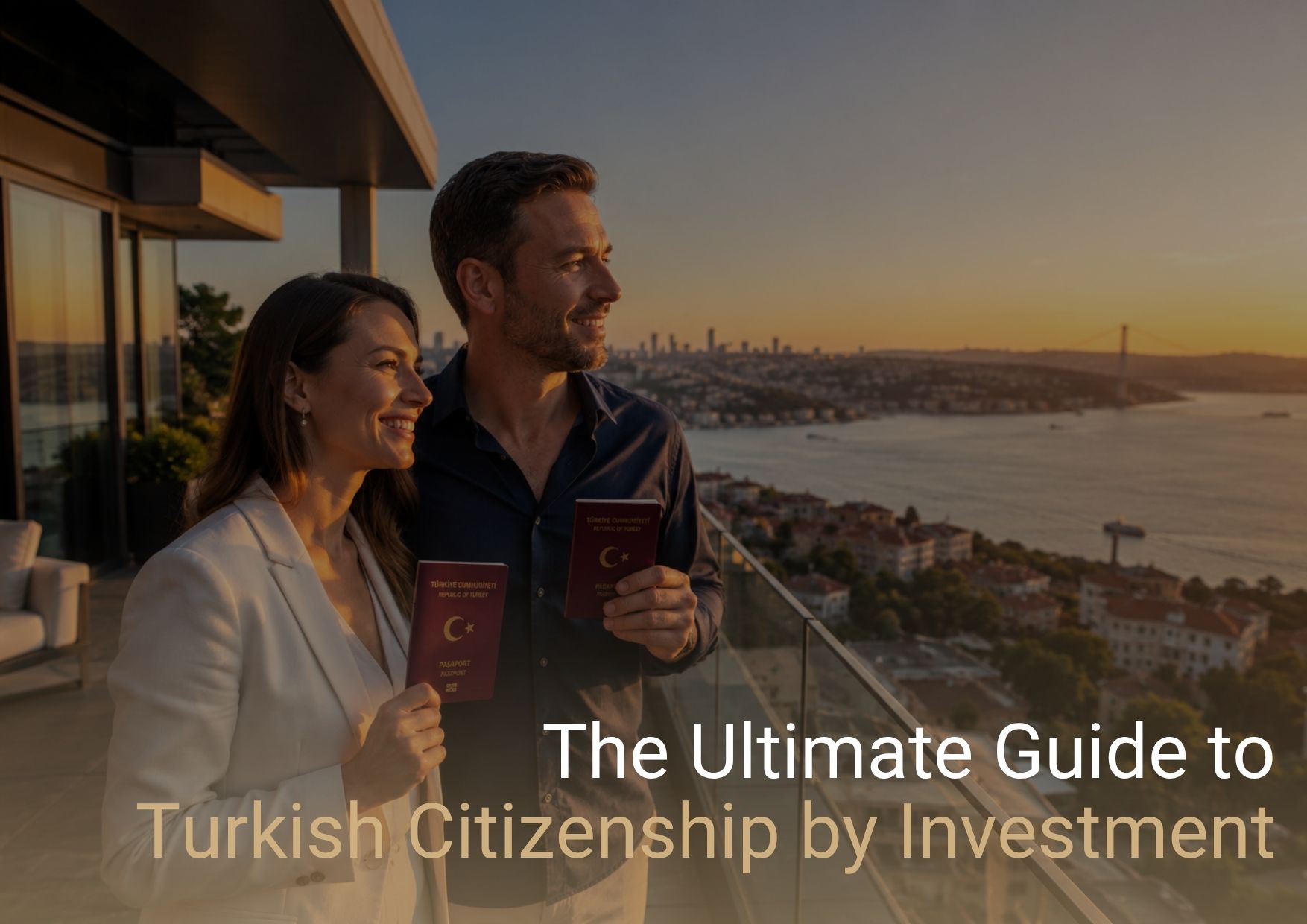
Turkish citizenship by investment is an exceptional route that allows foreign investors to acquire Turkish citizenship by choosing one of 7 different investment routes. The best-known path is real estate purchase (a minimum of USD 400,000, held with a 3-year non-sale annotation), but applicants can also qualify through fixed capital investment, a bank deposit, government bonds, an investment fund share, job creation, or a private pension system contribution — each requiring a minimum of USD 500,000 (or 50 employees for the job-creation route). The process takes an average of 3–6 months; the applicant's spouse and children under 18 gain citizenship in the same application.
Most guides online only cover the real estate route. In this guide, we cover all 7 investment routes, current 2026 figures, the step-by-step application process, real cost items, the tightened oversight rules introduced between 2024 and 2026, and everything is grounded in official and verifiable sources.
What Is Turkish Citizenship by Investment?
Citizenship by investment is one of the "exceptional citizenship" acquisition routes regulated under Article 12 of Turkish Citizenship Law No. 5901. The type of investment and its minimum thresholds are set by Article 20 of the Regulation on the Implementation of the Turkish Citizenship Law, and current thresholds are revised by Presidential Decree. Final approval of an application is likewise granted by Presidential Decree and takes legal effect once published in the Official Gazette.
This is Turkey's version of what is known worldwide as a "citizenship by investment (CBI)" program — it allows an investor to obtain citizenship by holding a qualifying investment for a minimum period, without any requirement to actually live in Turkey.
2026 Conditions — Quick Summary
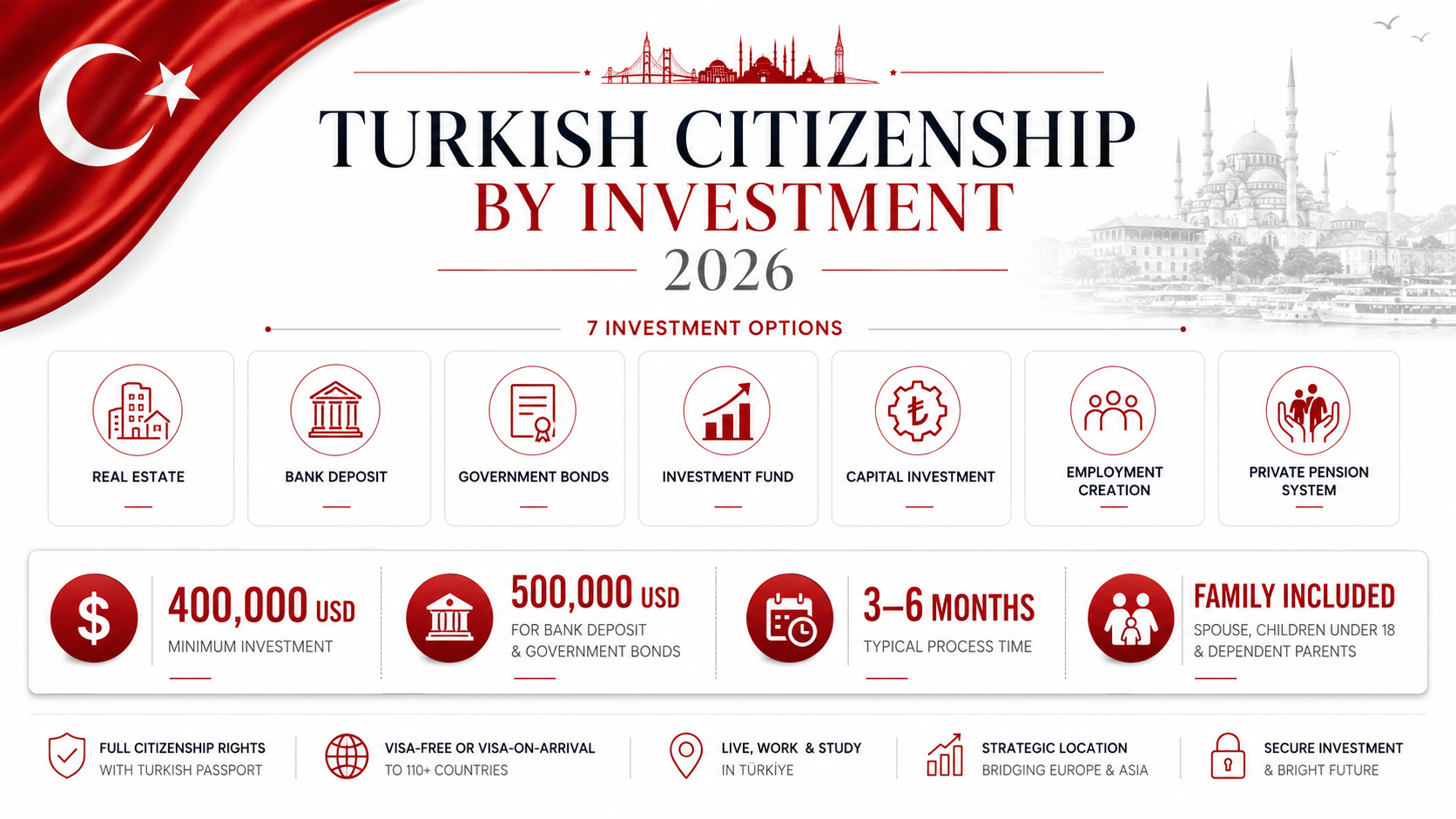
|
Criteria |
Current Status (2026) |
|
Number of investment routes |
7 |
|
Lowest minimum amount |
USD 400,000 (real estate) |
|
Minimum amount for other routes |
USD 500,000 |
|
Job-creation route |
50 employees |
|
Holding period |
Generally 3 years |
|
Average processing time |
3–6 months (some sources cite 6–12 months) |
|
Family coverage |
Spouse + children under 18 |
|
Dual citizenship |
Permitted |
The 7 Investment Routes — Not Just Real Estate
Most content online frames this program simply as "buy a house for $400,000 and get citizenship." In reality, official regulation defines 7 distinct investment routes. Before deciding which route fits you, it is worth knowing all of them.
1. Real Estate Purchase — USD 400,000
The most commonly chosen route. Residential, commercial, or land-type immovable property in Türkiye must be valued at a minimum of USD 400,000 per a report from a CMB-licensed appraisal institution, and a 3-year non-sale annotation is placed on the title deed. Approving authority: Ministry of Environment, Urbanization and Climate Change. (See the "The Real Estate Route in Detail" section below.)
2. Fixed Capital Investment — USD 500,000
Requires the Ministry of Industry and Technology to confirm a minimum of USD 500,000 in fixed capital investment in Türkiye. Generally suited to entrepreneurs investing in a production facility, factory, or business.
3. Bank Deposit — USD 500,000
Applies when a minimum of USD 500,000 (or the equivalent in foreign currency/Turkish lira) is deposited in a bank operating in Türkiye and held for 3 years without withdrawal. Approving authority: Banking Regulation and Supervision Agency (BRSA). A preferred route thanks to its liquidity and operational simplicity.
4. Government Debt Instruments — USD 500,000
Requires purchasing a minimum of USD 500,000 in government bonds/debt instruments issued by the Turkish Treasury and holding them for 3 years. Approving authority: Ministry of Treasury and Finance.
5. Real Estate or Venture Capital Investment Fund Share — USD 500,000
A participation share in a real estate investment fund (REIF) or venture capital investment fund (VCIF) established by the Capital Markets Board (CMB) is purchased for a minimum of USD 500,000 and tracked for 3 years by the Central Securities Depository (CSD) through a "Citizenship Blockage Sub-Account." Suited to investors seeking portfolio diversification who do not wish to manage property directly.
6. Job Creation — 50 People
Applies when the Ministry of Labor and Social Security confirms that a minimum of 50 jobs have been created at a business. Unlike the other routes, this one is based on employee headcount rather than a fixed dollar amount.
7. Private Pension System (PPS) Contribution — USD 500,000
This is the route most guides overlook: a minimum of USD 500,000 is contributed to a licensed private pension company in Türkiye and held in the system for 3 years, subject to approval by the Insurance and Private Pension Regulation and Supervision Agency (IPPRSA).
Note: Because the minimum amount and duration details of the PPS route are not clearly stated in some secondary sources, investors considering this route are advised to obtain current confirmation from IPPRSA.
Which Investment Route Suits You? — Comparison Matrix
|
Route |
Minimum |
Holding |
Liquidity |
Best For |
|
Real Estate |
USD 400,000 |
3 years |
Low–Medium |
Investors wanting rental income + appreciation |
|
Fixed capital |
USD 500,000 |
— |
Low |
Entrepreneurs setting up a business in Türkiye |
|
Bank deposit |
USD 500,000 |
3 years |
High (at maturity) |
Passive, low-effort investors |
|
Government bonds |
USD 500,000 |
3 years |
Medium |
Fixed-income seekers, low-risk profile |
|
Investment fund share |
USD 500,000 |
3 years |
Medium |
Investors wanting portfolio diversification |
|
Job creation |
50 employees |
— |
— |
Investors actively running a business in Türkiye |
|
Private pension (PPS) |
USD 500,000 |
3 years |
Medium–Low |
Long-term, low-effort profile |
Overall Assessment
The real estate route is preferred by the majority of investors, both because its minimum amount is USD 100,000 lower than the other routes and because it offers the potential for rental income plus capital appreciation. However, for investors who do not want to tie up capital in property, or who want a different portfolio balance, the bank deposit, government bond, and fund-share routes reach the same goal with a lighter operational load.
The Real Estate Route in Detail

Since real estate is the most popular route, its technical details deserve closer attention:
- A CMB-licensed appraisal report is mandatory. The property's appraised value — independent of the contract price — must meet the USD 400,000 minimum.
- Centralized valuation (GEDAŞ): Under General Communiqué No. 2024/2 of the Land Registry and Cadastre Directorate (TKGM), citizenship-related appraisals are now carried out centrally through GEDAŞ Gayrimenkul Değerleme A.Ş., a TOKİ affiliate; investors can no longer freely choose their own appraiser for this purpose.
- Foreign Exchange Purchase Certificate (DAB): The payment must enter a Turkish bank from abroad in foreign currency, and this inflow must be documented with a DAB.
- CBRT exchange rate: The Turkish lira equivalent of the USD-denominated amount is calculated using the Central Bank of the Republic of Türkiye (CBRT) selling rate on the transaction date.
- Single-contract rule: It is possible to reach the minimum amount with more than one property, but all of them must fall under a single sales contract; reaching the total through separate contracts is not accepted.
- Shared/co-ownership is not accepted. The title deed must be entirely in the applicant's name.
- A 3-year non-sale annotation is recorded on the title deed; selling before this period expires can lead to revocation of citizenship.
Step-by-Step Application Process
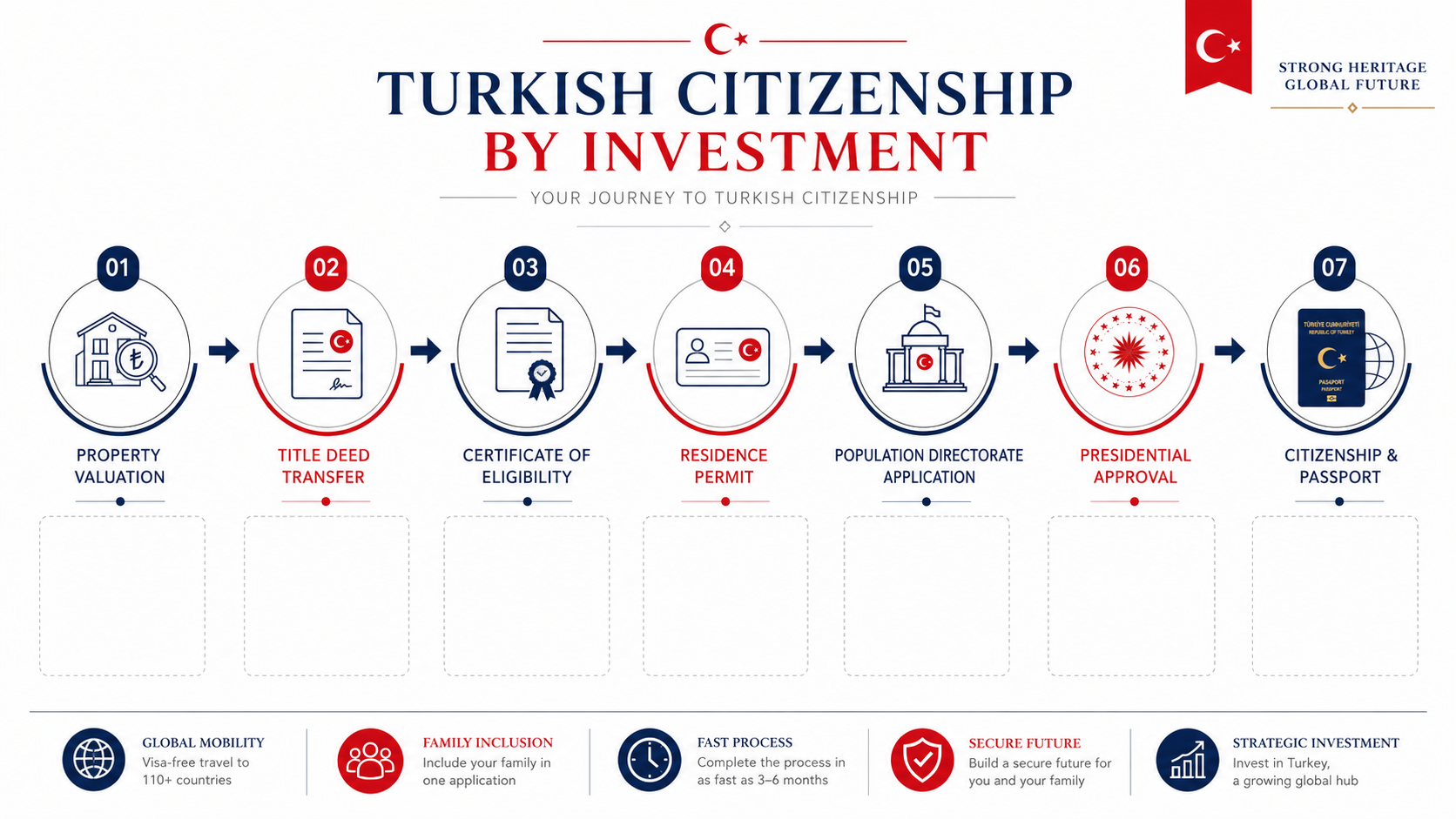
-
Appraisal / valuation report — issued by a CMB-licensed institution (GEDAŞ for real estate); carried out through TKGM's webtapu system.
-
Completion of the investment — for real estate, title transfer at the Land Registry Office (documented with a DAB for the foreign-currency inflow); for other routes, the investment is made with the relevant institution (bank, brokerage, Treasury, etc.).
-
Certificate of Conformity: For real estate, this is the document issued by the provincial Land Registry Directorate, referred to since 2024 as the "Immovable Investment Determination Certificate (TYTB)." For the other routes, the relevant regulator (deposit → BRSA, bonds → Ministry of Treasury and Finance, fund → CMB, job creation → Ministry of Labor and Social Security, fixed capital → Ministry of Industry and Technology, PPS → IPPRSA) issues a similar determination/conformity certificate.
-
Residence permit — a short-term residence permit is obtained from the Presidency of Migration Management during the application process.
-
Citizenship application (NVI) — the application is submitted to the Directorate General of Civil Registration and Citizenship Affairs (NVİ) together with the conformity certificate, passport, apostilled birth/marriage certificates, and documents proving the source of funds.
-
Final decision — a Presidential Decree is issued on the recommendation of the Ministry of Interior; citizenship is formally acquired once the decree is published in the Official Gazette.
How long does the process take? Sources vary: Türkiye-based law firms generally cite 3–6 months, while international advisory firms cite a 6–12 month range. For investors who apply with a complete file and a clean case, the process is typically completed in around 6–9 months.
Required Documents

- Valid passport (with a notarized Turkish translation)
- Conformity/determination certificate (from the relevant authority, depending on the investment route)
- Foreign Exchange Purchase Certificate (DAB) — for the real estate route
- Residence permit document
- Apostilled birth certificate
- Apostilled marriage certificate (if the spouse is to be included)
- Biometric photograph
- Bank documents showing the source of funds (12-month account statement, income/tax documents) — within the scope of MASAK (financial crimes) review
- Criminal record certificate (may be requested in some cases)
- Power of attorney (if the process is being handled through a lawyer)
Note: The document list may vary by investment route and by nationality; confirm the current list with the relevant authority or your advisor before applying.
Total Costs and Taxes
Beyond the investment amount itself, additional costs arise at various stages of the process:
|
Item |
Approximate Rate/Amount |
Note |
|
Appraisal (valuation) fee |
Not fixed |
Via GEDAŞ for real estate |
|
Title deed fee |
~4% (in practice usually paid by the buyer) |
Confirm the current rate with the Revenue Administration/Land Registry |
|
VAT exemption |
Conditional exemption |
Requires foreign-currency inflow and first sale; property must be held 1 year — confirm current conditions |
|
Revolving fund fee |
Variable |
Per transaction |
|
Sworn translation / notary / apostille |
Variable |
Depends on number of documents |
|
Legal / advisory fees |
Variable |
Firm-dependent |
|
Citizenship application fees |
Variable |
Per the NVÎ fee schedule |
Important: The percentages for the title deed fee and VAT exemption are based on secondary sources. We recommend confirming the exact, current rates with the Revenue Administration, the Land Registry and Cadastre Directorate, or a licensed financial advisor before applying.
What Changed Between 2024 and 2026?
The minimum investment amounts did not change during 2024–2025 (USD 400,000 for real estate, USD 500,000 for the other routes remained fixed). However, there has been a clear tightening on the oversight and procedural side:
- Centralized valuation (GEDAŞ): Under TKGM General Communiqué No. 2024/2, valuation reports are now issued exclusively through GEDAŞ, a TOKİ affiliate.
- Cross-checking: Valuation reports are now cross-checked against the title deed sale price and the property tax value; if the state appraiser values the property below the minimum threshold (e.g. USD 399,000), the application is directly rejected.
- MASAK source-of-funds review: Under Law No. 5549, the source of the investment amount is examined more strictly (12-month account statements, income/tax documents, apostille and sworn translation requirements).
- Anti-cycling checks: Properties that changed hands at a low price shortly before transfer to the investor, or transactions showing an unusual price increase in a short period, are subject to additional scrutiny.
Warning: Fraud and Rejection Reasons
The program's popularity has also attracted attempts at abuse. The most important recent development to be aware of:
September 2025 operation: The Ministry of Interior dismantled a network that was arranging citizenship through fraudulent sales transactions. The operation involved 106 people detained across 19 provinces, and the files of approximately 451 foreign investors were placed under review. Citizenship obtained through fake or incorrect documents can be retroactively revoked, along with that of family members, under Law No. 5901.
Common Rejection Reasons
- A mortgaged property or one with a pending legal dispute
- Shared/co-ownership (the title deed is not entirely in the applicant's name)
- Attempting to reach the minimum amount through multiple separate contracts
- Inability to document the foreign-currency inflow (DAB)
- A state appraiser's valuation coming in below the minimum threshold
Practical advice: Handling the process through an experienced, officially registered law firm or advisory company specializing in title deed and immigration matters prevents most of these risks.
History of the Real Estate Threshold
The program's real estate threshold has changed several times over the years:
- Initial threshold: USD 1,000,000
- 18 September 2018: Lowered to USD 250,000
- 13 May 2022: Raised to USD 400,000 by Presidential Decree; the decision applied to contracts executed from 13 June 2022 onward.
An unverified claim to watch for: In December 2023, some news outlets reported that the threshold would be raised to USD 600,000 in 2024. This change never took effect; the current threshold remains USD 400,000. When following such reports, we recommend always verifying against the official Official Gazette record or invest.gov.tr.
Advantages of Turkish Citizenship

- A strong passport: The Turkish passport ranks 46th on the Henley Passport Index 2025 and grants visa-free or visa-on-arrival access to more than 110 countries.
- Dual citizenship is permitted: Türkiye allows dual citizenship; you do not need to give up your existing citizenship unless your home country's laws prohibit it.
- Family coverage: The applicant's spouse and children under 18 acquire citizenship in the same process.
- Access to the US E-2 Investor Visa: Thanks to the trade treaty between Türkiye and the United States, Turkish citizens can apply for the E-2 Treaty Investor visa without a fixed minimum investment amount or quota requirement — a significant added benefit for high-net-worth investors.
- Geographic and economic proximity to the EU, Türkiye's Customs Union status, and its growing economy.
Turkey vs Other Citizenship/Residency Programs
|
Country/Program |
Minimum Investment |
Processing Time |
Key Difference |
|
Türkiye |
USD 400,000 (real estate) |
~3–9 months |
Direct citizenship (no residency phase) — one of the fastest programs |
|
Greece (Golden Visa) |
~EUR 250,000–800,000 (by region) |
Residence permit; citizenship requires ~7 more years of residency |
Not direct citizenship — residency first |
|
Portugal |
Fund-based Golden Visa routes (real estate closed in most regions) |
Residence permit; citizenship requires ~5 years |
Not direct citizenship — residency first |
|
Caribbean CBI programs (e.g. Grenada, Dominica) |
~USD 100,000–200,000 (donation) |
~3–6 months |
Fast, but passport strength and EU/US visa access differ |
Turkey's key differentiator: Most European "golden visa" programs grant a residence permit first and require years of residency before citizenship. In Türkiye, once the investment conditions are met, citizenship is granted directly — the fundamental difference that significantly shortens the overall timeline.
Note: Figures in this table belong to country-specific programs that change frequently; confirm current details with each country's official source before applying.
Investing in Istanbul for the Real Estate Route
For investors choosing the real estate route toward citizenship by investment, Istanbul remains Türkiye's most attractive market, both for rental yield and for capital appreciation potential. Choosing the right district and the right property is critical not only for meeting the USD 400,000 threshold but for securing a genuine long-term return on investment. From the appraisal report to the title transfer, and from the Conformity Certificate application to the NVÎ process, every step carries a different risk and return profile depending on the district and project selected — which is why we recommend comparing regional rental-yield and appreciation data before making a purchase decision.
Frequently Asked Questions
Is it mandatory to live in Türkiye to obtain citizenship by investment?
No. There is no residency requirement in Türkiye once citizenship has been acquired.
What routes are there besides real estate?
There are six alternative routes: fixed capital investment, bank deposit, government debt instruments, investment fund share, job creation, and private pension system contribution.
Why is the minimum amount lower for real estate?
Official regulation sets real estate at USD 400,000 and the other six routes at USD 500,000; the exact rationale is tied to economic incentive policy as stated in the public regulatory text.
How long does the process take?
This varies by source, but it generally takes 3–6 months, and can extend up to 6–12 months in some cases.
Who should I get citizenship-by-investment advice from?
Working with an officially registered law firm or an experienced investment advisory company that is well versed in title deed, immigration, and MASAK (financial crimes) procedures both speeds up the process and reduces rejection risk.
Can I sell the property before 3 years are up?
No. Selling before the 3-year non-sale annotation on the title deed expires risks revocation of citizenship.
Can I reach USD 400,000 with several smaller properties?
Yes, but all properties must fall under a single sales contract; reaching the total through separate contracts is not accepted.
Can I buy a mortgaged property?
A mortgaged property or one with an ongoing legal dispute can lead to rejection of the application; it is advisable for the mortgage to be cleared first.
Can I apply with a shared/co-owned title deed?
No, the title deed must be entirely in the applicant's name.
Can I choose my own appraiser for the valuation report?
No, as of 2024 real estate valuations for citizenship purposes are carried out centrally through GEDAŞ.
Can I benefit from the VAT exemption?
Under certain conditions (foreign-currency inflow, first sale, holding period), a VAT exemption may apply to foreign buyers; we recommend confirming the current conditions before the transaction.
Who pays the title deed fee?
In practice it is generally paid by the buyer; the exact rate and split should be confirmed against current legislation.
What currency is the investment amount fixed in?
Amounts are fixed in USD; the Turkish lira or other currency equivalent is calculated using the CBRT selling rate on the transaction date.
Will I have military service obligations?
Adults who become citizens through investment are, in practice, exempt from military service; however, the situation may differ for male children under 18. We recommend confirming this current detail with NVÎ.
Can I include my parents in the citizenship application?
No. Coverage is limited to the spouse and children under 18; parents cannot be included in this program.
Can my child who has turned 18 still acquire citizenship?
No, only children under 18 are covered by the same application; a separate route is required for adult children.
Do I need to give up my current citizenship if I become a Turkish citizen?
No, Türkiye allows dual citizenship. However, you should also check your own country's dual citizenship policy.
What happens if my citizenship application is rejected?
Administrative or judicial appeal routes are available against a rejection decision; we recommend seeking support from a legal advisor at this stage.
How many countries can I travel to visa-free with a Turkish passport?
According to the Henley Passport Index 2025, the Turkish passport ranks 46th and provides visa-free or visa-on-arrival access to more than 110 countries.
Does the US E-2 investor visa come automatically?
No, Turkish citizenship provides the nationality required to apply for the E-2 visa; the visa application must be made separately and must meet its own separate conditions.
What happens if fake documents or value manipulation are detected?
Citizenship can be retroactively revoked, along with that of family members, under Law No. 5901; criminal liability may also arise.
Is the investment fund (REIF/VCIF) route safe?
This route operates under CMB supervision, monitored weekly by the Central Securities Depository through a "Citizenship Blockage Sub-Account" — a transparent structure from a regulatory standpoint. Fund performance itself remains subject to market risk.
Within what timeframe must the 50 employees be hired under the job-creation route?
This detail depends on the implementation rules of the Ministry of Labor and Social Security; you should confirm the current timeframe with the relevant ministry before applying.
The information in this article is based on official and secondary sources current as of the publication date; because regulations change frequently, we recommend confirming with the relevant official authorities or a legal advisor before applying. This content does not constitute legal advice.