Title deed transfer in Turkey: step by step 2026
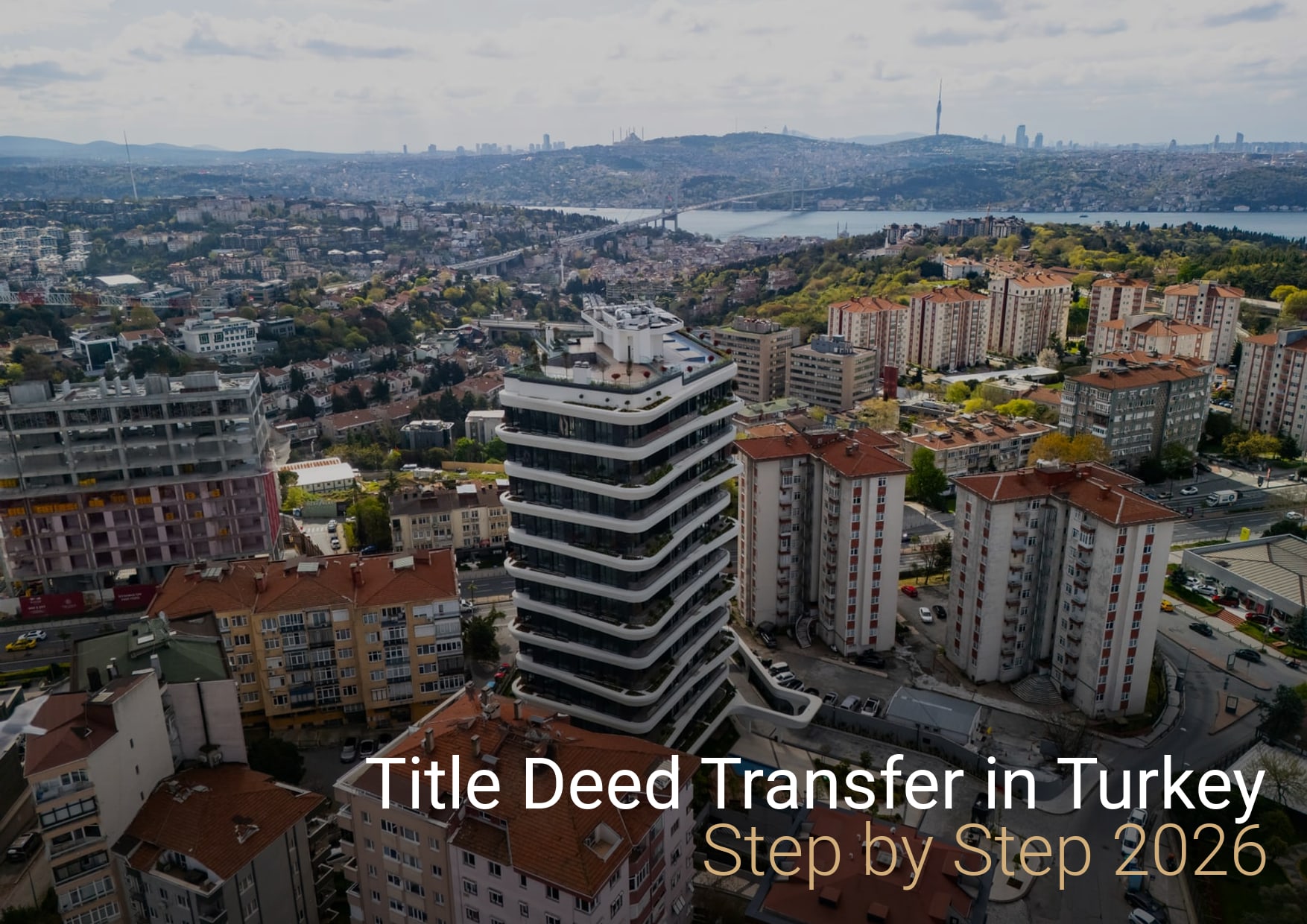
The sale of a home in Turkey is completed in the few minutes when buyer and seller sign side by side at the land registry office. Whether those minutes go smoothly depends on the preparation before them: the right application, a complete set of documents, the fee paid, and a clear plan for how the money will change hands. In this guide we walk through a title deed transfer step by step, from the application to the moment the new title deed (tapu) is in your hands. You will also find below the payment rule that changes from 1 December 2026.
1. Check the title deed record before the sale
Before you book an appointment, see the title deed record of the home being sold. If the record carries a mortgage, an attachment or an annotation, either the sale cannot go ahead at all or a burden passes to the buyer. If the home is pledged to a bank, agree before the sale how the mortgage will be lifted. Look at the type of title too: is it a land share, kat irtifakı (a title for a building not yet completed) or kat mülkiyeti (full condominium ownership)? We explain the difference in our article on kat irtifakı and kat mülkiyeti, and why it matters for new buildings in what is iskan. For a broader checklist, see our article on what to consider when buying a house.
2. Application and appointment through Web Tapu
Today most sale applications are made through Web Tapu, the land registry's online service, signing in with an e-Devlet (Turkey's e-government portal) password. You can also apply through the Alo 181 helpline or directly at the land registry office. The process runs roughly like this:
- The sale application is filed, the property and party details are entered, and the sale price is declared.
- The land registry office reviews the application and the documents.
- You are told the title deed fee and the döner sermaye (service fee) to be paid.
- Once payment is made, your appointment is confirmed and you are given a day and time.
A missing or incorrect document usually comes to light at this stage. Better here than on the day of the appointment.
3. Documents needed for a title deed transfer
- Identification. A valid identity document for both buyer and seller.
- DASK policy. No residential property can be transferred without a valid DASK policy, Turkey's compulsory earthquake insurance. If it has expired, renew it before the appointment.
- Valuation letter from the municipality. A letter showing the property's value for property tax purposes (the rayiç bedel certificate).
- Passport-size photo. The office may ask for one, so have it with you.
- Power of attorney. If either party is acting through a representative, make sure the power of attorney states the authority to sell or to buy explicitly.
- For companies, a signature circular and a document of authority.
The original title deed is usually not required, because the record is held electronically. Still, keeping its details to hand makes things easier.
4. Title deed fee and döner sermaye
On a sale, the title deed fee is 4% of the declared price. By law the buyer pays 2% and the seller pays 2%. The parties may agree a different split between themselves, but in the eyes of the land registry office both are liable. The declared price cannot be lower than the property tax value set by the municipality.
Declaring a price below the real sale price used to be a common habit. Today it is both risky and expensive: under an amendment made in December 2025, the tax loss penalty for under-declaring was raised to one times the unpaid fee. There is a seller's side to this as well. When the home is sold later, an understated purchase price inflates the capital gains tax.
Alongside the fee, a döner sermaye charge is paid. In 2026 this is 6,681 TL for a sale in Istanbul and 5,567.50 TL in districts such as Bodrum and Marmaris. If a mortgage loan is used, the mortgage is registered as a separate transaction. A mortgage tied to a bank loan is exempt from the fee, but its döner sermaye is still paid.
To see your own figure, you can use our title deed fee calculator. We have gathered the other costs of buying in our article on the expenses of buying a home.
5. Payment: the secure payment system from 1 December 2026
The tensest moment at the land registry is when the money changes hands. The buyer does not want to sign before sending the money, and the seller does not want to hand over the title before seeing it. This is why the Ministry of Trade introduced the secure payment system. Under an amendment to the Regulation on Real Estate Trade made on 1 October 2026, the system is mandatory from 1 December 2026.
Here is how it works: the price the buyer pays waits in a blocked account until the transfer is complete. Once the transfer goes through at the land registry, the money passes to the seller. Neither side has to rely on trusting the other.
The integrator that will run the system, the fee for using it, and which sales will fall outside it are to be set by a protocol between the Ministry and the institutions involved. We will update this section as the details become clear. Until then, we recommend paying by bank transfer rather than in cash, with the property details written in the transfer description.
6. Appointment day at the land registry office
At the appointment time, buyer and seller are at the land registry office, together with any representatives and an interpreter. The officer checks identities and documents, asks the parties whether they really want to make this sale, and reads out the official deed. Make sure the price written in the deed is the same as the price you declared. Once the parties sign, ownership has passed to the buyer. You can see the new title deed record straight away on e-Devlet, and the title deed itself is issued by the office.
If you want no surprises at this stage, gather the fee receipt, the DASK policy and the identity documents in one folder the day before. At the land registry, most of the work comes down to having every document in order.
7. Additional steps for foreign buyers
For a buyer who is a foreign national, the process is the same, with a few documents added:
- Passport, with a translation where required.
- Tax number. Obtained quickly from the tax office with your passport.
- Sworn interpreter. Must be present during the transaction for any party who does not speak Turkish.
- Photos. The guide published by TKGM (the General Directorate of Land Registry and Cadastre) asks a foreign buyer for two passport-size photos taken within the last six months.
- Currency exchange certificate. For purchases by foreign individuals, a document showing the foreign currency was converted at a bank in Turkey has been submitted to the land registry since 2022.
A valuation report was required on every sale to a foreigner from 2019 to 2024. A circular in June 2024 removed that requirement. Today the report is needed only if the purchase is being made for a Turkish citizenship application. For a wider guide aimed at foreign investors, see our article on buying property in Istanbul.
8. After the sale
- For the buyer: Transfer the electricity, water and gas accounts into your name. Property tax is now your responsibility. You can see how much it will be with our property tax calculator.
- For the seller: If you are selling before five years have passed, your gain may be taxable. You can check whether anything is payable with our capital gains tax calculator.
With good preparation, a title deed transfer is a straightforward transaction. When you buy a home through us, we are with you at every step, from the application to the appointment day. If anything is on your mind, write to us and we will look at it together.